Educational guide
Understanding kidney failure
Chronic kidney disease is a silent illness. Caught early, it can be slowed, sometimes considerably. Here, in plain terms, is what you need to know.
This page is for information purposes only. It does not replace the advice of your GP or your nephrologist, who remains the best person to assess your situation.
In a nutshell
Why this page
Chronic kidney disease sets in slowly, often quietly, and many people are unaware of it for years. The good news is that a simple blood test can pick it up early, and there are now real ways to protect your kidneys, slow the disease and carry on living a full life.
Anatomy
What your kidneys do
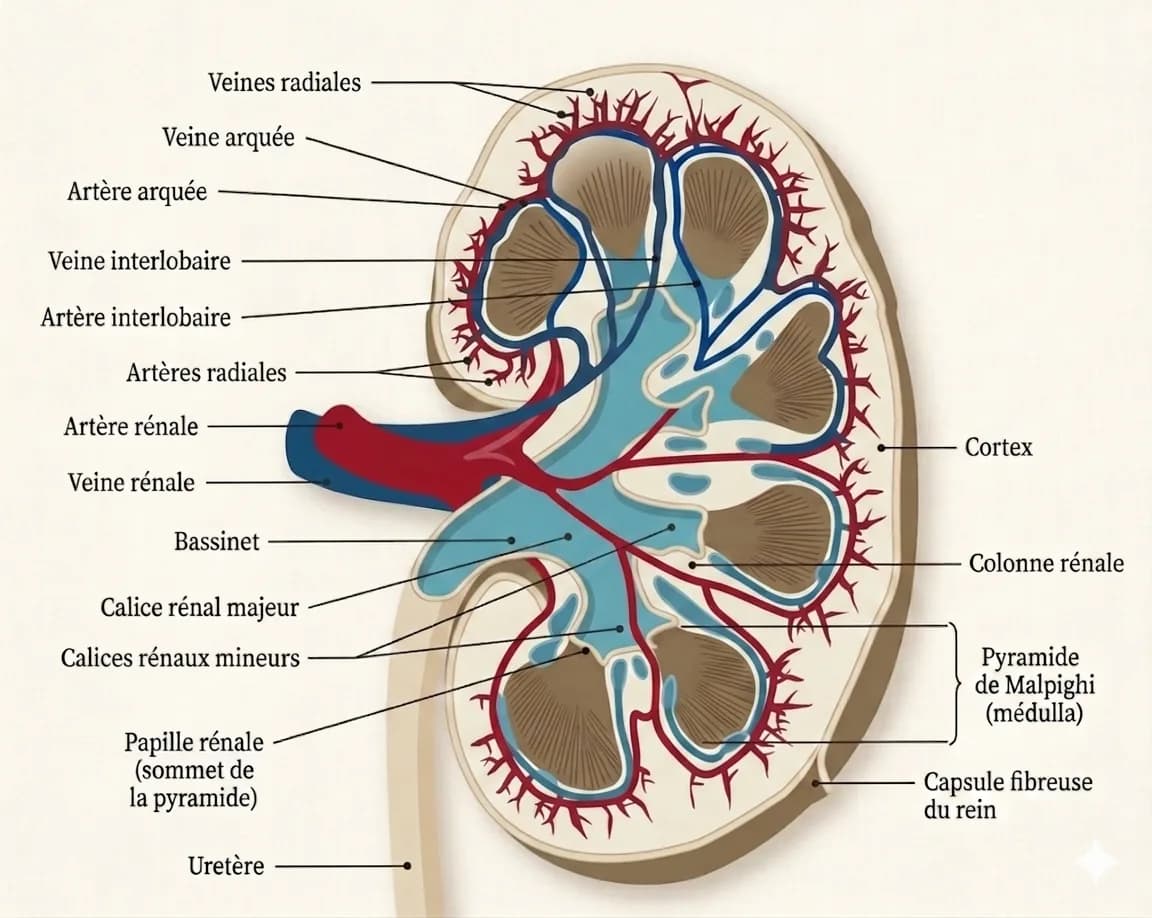
You have two kidneys, located in the lower back, on either side of the spine. Each one weighs barely 160 grams — about the size of a large bean.
Think of them as two very fine filters. Day and night, all of your blood passes through them to be cleaned: they keep what is useful (proteins, blood cells) and let what the body no longer needs (excess water, salt, waste products such as urea and creatinine) pass out into the urine.
The kidneys do other things too: they help to regulate blood pressure, to keep bones strong and to make red blood cells. When they are working well, you don't feel them — and that is precisely why it is sometimes worth checking that they are in good order.
What is chronic kidney disease?
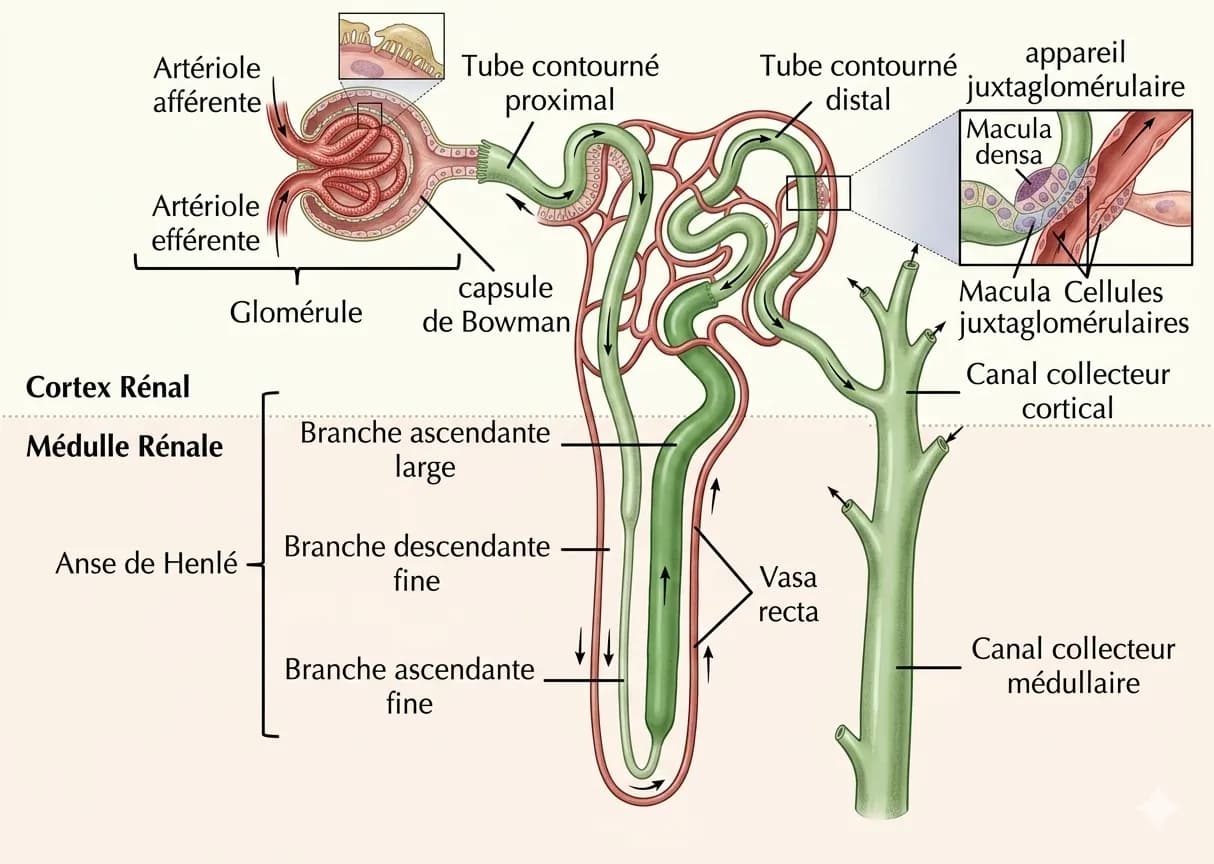
The kidneys are made up of tiny microscopic filters called nephrons. When some of them are permanently damaged — by diabetes, high blood pressure or other causes — they do not regenerate. The kidney keeps working, but a little less well.
We talk about chronic kidney disease when this loss of function persists over time (more than three months). It is often painless and gradual, which is why it is frequently discovered during a routine check-up. The earlier it is detected, the more can be done.
A closer look at the nephron
One million microscopic filters per kidney
Each kidney contains around one million nephrons, the microscopic units that filter your blood continuously. In the diagram you can see the glomerulus — the filter itself, where blood passes through a fine membrane — and then the whole system of tubules that fine-tunes the composition of the urine by reclaiming what should be kept (water, salts, glucose) and letting the waste products flow on towards the collecting duct.
This miniaturised mechanism is repeated one million times per kidney. As long as enough nephrons are working, the kidney compensates — which is why you can lose part of your kidney function without feeling anything. The catch: by the time the first symptoms appear, often fewer than 30% of nephrons are still working.
Understanding the nephron means understanding why a simple blood test is so valuable: it measures creatinine, a waste product that healthy nephrons clear away. Its silent rise in the blood is the first signal — well before the body shows any sign.
The warning signs
Which symptoms should raise the alarm?
Kidney failure advances quietly. But certain signals can put you on alert.
At first, you may notice
- Unusual tiredness that appears even after light exertion
- A loss of appetite
- The need to get up several times during the night to pass urine
- Rising blood pressure, or swelling (ankles, face)
Later on, these may be added
- Digestive problems: aversion to meat, nausea, vomiting
- Weight loss and more marked tiredness
- Cramps or restless legs, especially at night
- Itching, sometimes intense
- Disturbed sleep
Good to know
Even at an advanced stage, before dialysis, you continue to pass urine normally. The absence of urine is therefore not a criterion. If several of these signs apply to you, talk to your doctor — it isn't necessarily the kidneys, but it is worth checking.The 5 stages
Where do you stand on the map?
Doctors assess how well the kidneys are working using the glomerular filtration rate (GFR), calculated from a simple blood test.
| Stage | Description | GFR (ml/min/1.73 m²) |
|---|---|---|
| 1 | Normal kidney function | > 90 |
| 2 | Mild kidney failure | 60 – 89 |
| 3 | Moderate kidney failure | 30 – 59 |
| 4 | Severe kidney failure | 15 – 29 |
| 5 | End-stage kidney failure | < 15 |
At stage 5, renal replacement therapy becomes necessary: dialysis or a transplant. This table is not a foregone conclusion: above all it is a map to find your bearings. Detecting the disease at stages 1, 2 or 3 means giving yourself years to slow its progression, sometimes very effectively. That is the whole point of screening.
Who should be screened?
Should you be screened?
A check at least once a year is a good habit if you are in one of these situations.
- You have high blood pressure or diabetes
- You have a history of cardiovascular disease (arteries, heart)
- You are over 60 years old
- You have a family history of kidney disease or a genetic condition
- You have had several upper urinary tract infections or recurrent kidney stones
- You regularly take certain medicines that are hard on the kidneys (long-term anti-inflammatories, lithium, some chemotherapies…)
How screening works
Simple, quick, nothing invasive
- 1Blood test
Measurement of creatinine (a waste product that the kidneys normally clear away).
- 2A small calculation
Based on creatinine, your age and your weight (Cockcroft-Gault, MDRD, CKD-EPI formulas). The laboratory or the doctor takes care of it.
- 3Sometimes, a urine test
To check for the presence of albumin, another useful marker.
If there is any doubt or an abnormal result, your doctor will refer you to a nephrologist for specialist advice.
The most important message
“10% of cases of kidney failure can be prevented, and 30% can be delayed by several years — sometimes more than a decade.”
Acting early changes the trajectory. The recommendations rest on four pillars.
- Pillar 1
Adopt a few good habits
- Stop smoking
- Cut down on alcohol
- Stay active (30 minutes of walking a day)
- Keep your vaccinations up to date
- Avoid self-medication
- See your nephrologist at least once a year if you are at risk
- Pillar 2
Keep your blood pressure well controlled
- Measure your blood pressure at home when possible
- Cut down on salt
- Keep an eye on your weight
- Take your treatment regularly, without skipping doses
- Pillar 3
Protect your kidneys
- Avoid medicines that tire the kidneys (NSAIDs without advice)
- Moderate your intake of animal protein as advised by the nephrologist
- Keep cholesterol, triglycerides and diabetes well balanced
- Pillar 4
Understand your treatment and take part in it
- Know your medicines and what they are for
- Follow how your test results change over time
- Speak openly during consultations, without holding back
- An informed patient is a better-cared-for patient
Nephrology consultation
A doubt? A question? Let's talk it over.
Clinique ESSAADA offers nephrology consultations in Sidi Bel Abbès, to review your kidney function, interpret your test results, and build a plan with you to protect your kidneys over the long term.