Technical facilities
Measuring your dry weight and hydration precisely
Multi-frequency bioimpedance — the same measurement technology used in European nephrology centres, integrated into your dialysis follow-up.
Why this measurement
Going beyond the ordinary bathroom scales
In haemodialysis, weight is only part of the story. What really matters is the distribution between water, lean mass and fat mass. Ordinary scales cannot tell these apart.
Multi-frequency bioimpedance (BIS) sends an imperceptible electrical current at several frequencies through your body. Depending on the frequency, this current crosses cell membranes to a greater or lesser extent — which makes it possible to separate total body water, intracellular water, extracellular water, lean mass and fat mass.
It is a tool that complements the nephrologist's clinical assessment. It does not replace their judgement — it enriches it with objective data, tracked over time.
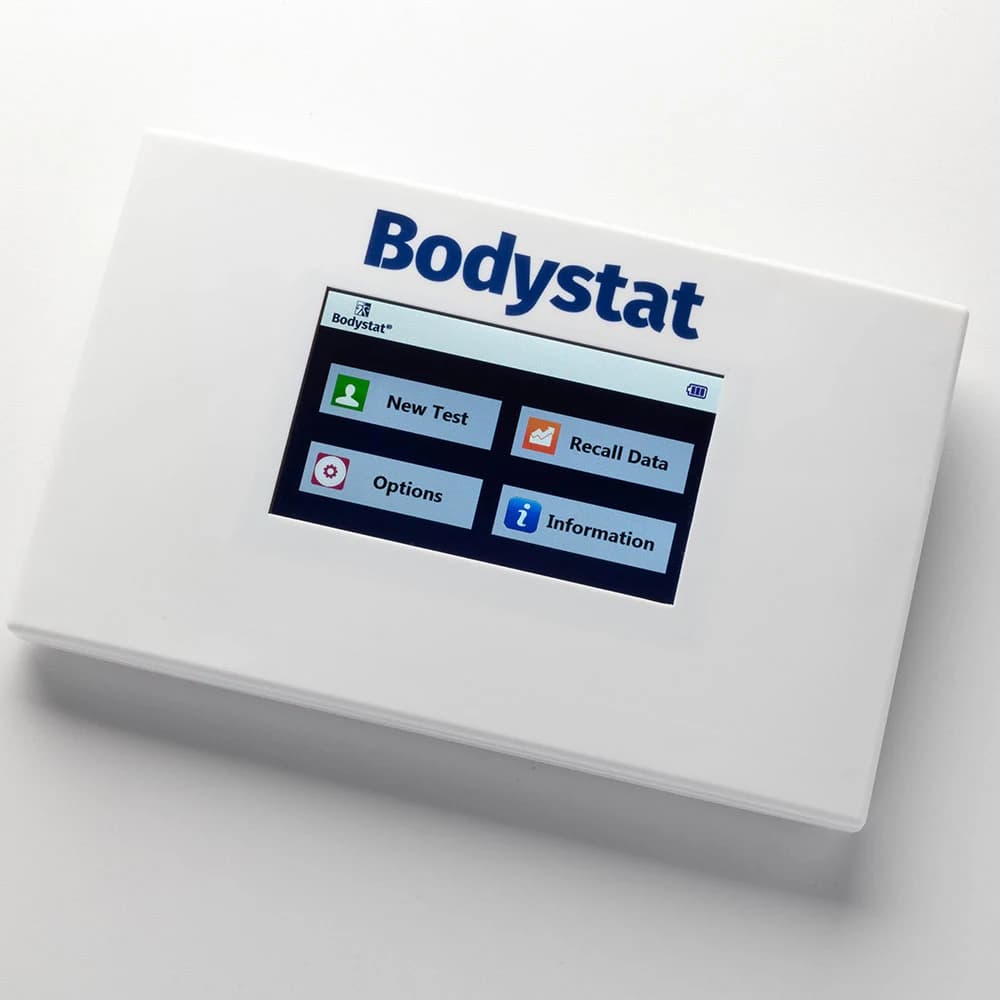
The device used
- Bodystat Multiscan 5000 — CE-marked medical device
- Bioimpedance at 6 frequencies (5 to 1000 kHz)
- Non-invasive, painless measurement, two minutes
- Interpreted by your nephrologist
Multi-frequency bioimpedance is used routinely in certain European nephrology centres. It remains higher-end equipment, still uncommon in Algeria.
What it does for you
Three concrete contributions to your follow-up
What this tool helps your nephrologist do better — and what it does not claim to do.
Adjusting the dry weight
The objective measurement of body water (total, intracellular, extracellular) helps your nephrologist fine-tune your dry weight, beyond clinical assessment alone. The aim: to limit intradialytic hypotension and fluid overload between sessions.
Tracking body composition
Lean mass, skeletal muscle mass, fat mass — tracked over time to detect muscle wasting (sarcopenia) or malnutrition, both common in end-stage kidney failure.
Reading the phase angle
The phase angle reflects the integrity of your cells. A marker recognised in the nephrology literature, it enriches the nutritional assessment and the general condition of the dialysis patient.
How it works
A measurement built into your visit, in four steps
No separate appointment: the measurement is taken before or after a session, within the unit.
- 1
Setting up
You lie down comfortably, fully clothed. No fasting, no injection required.
- 2
Placing the electrodes
Four adhesive electrodes (two on the hand, two on the foot), like an ECG. Painless.
- 3
Measurement
The device sends an imperceptible current at several frequencies (5 to 1000 kHz). Duration: about two minutes.
- 4
Reading & decision
The nephrologist interprets the results with you and adjusts your dialysis prescription if needed.
A sample report
What the report handed to your nephrologist looks like
Each indicator is placed on a visual scale (red / orange / green) showing where you stand relative to the reference ranges. The nephrologist discusses each zone with you.
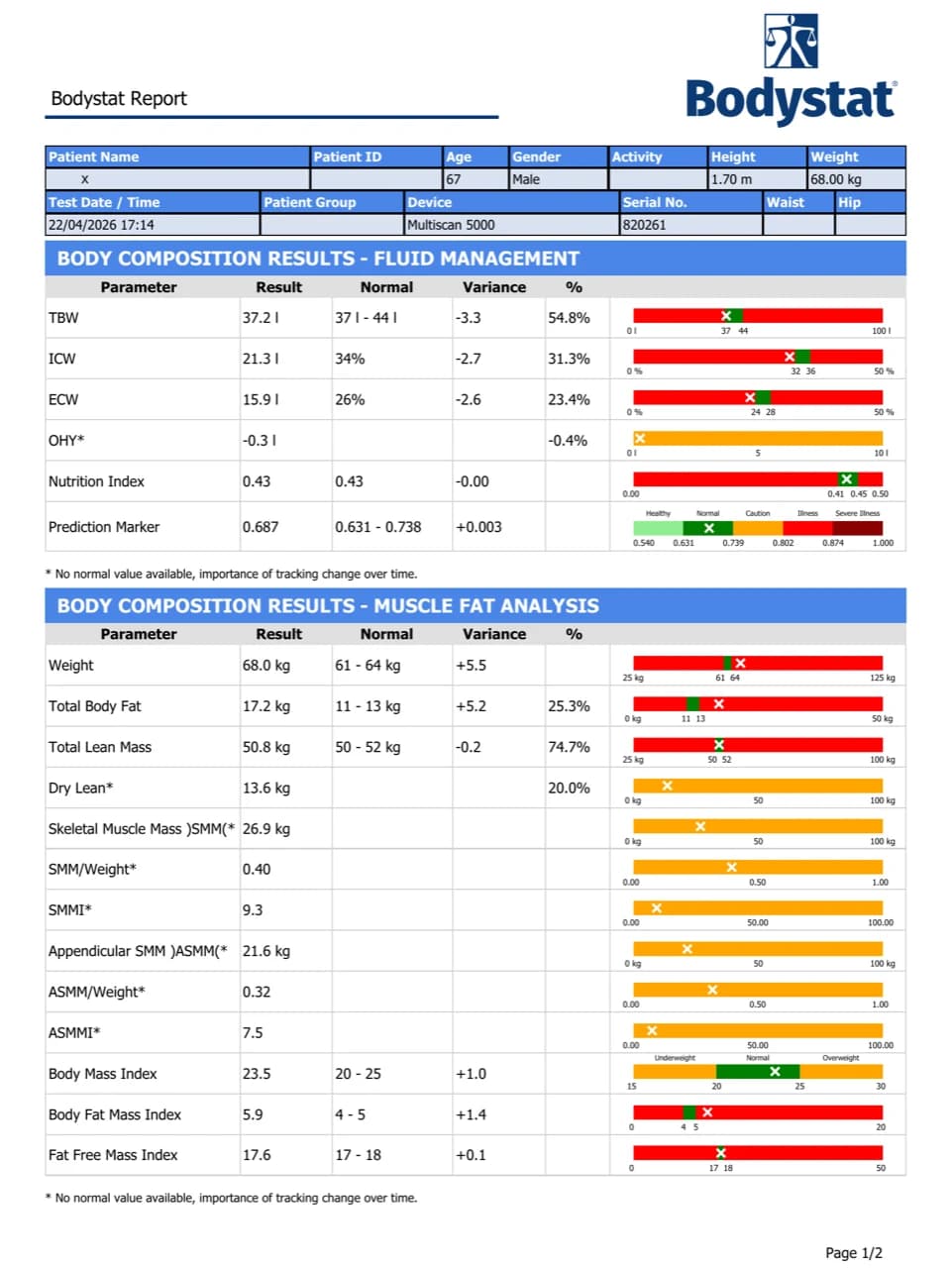
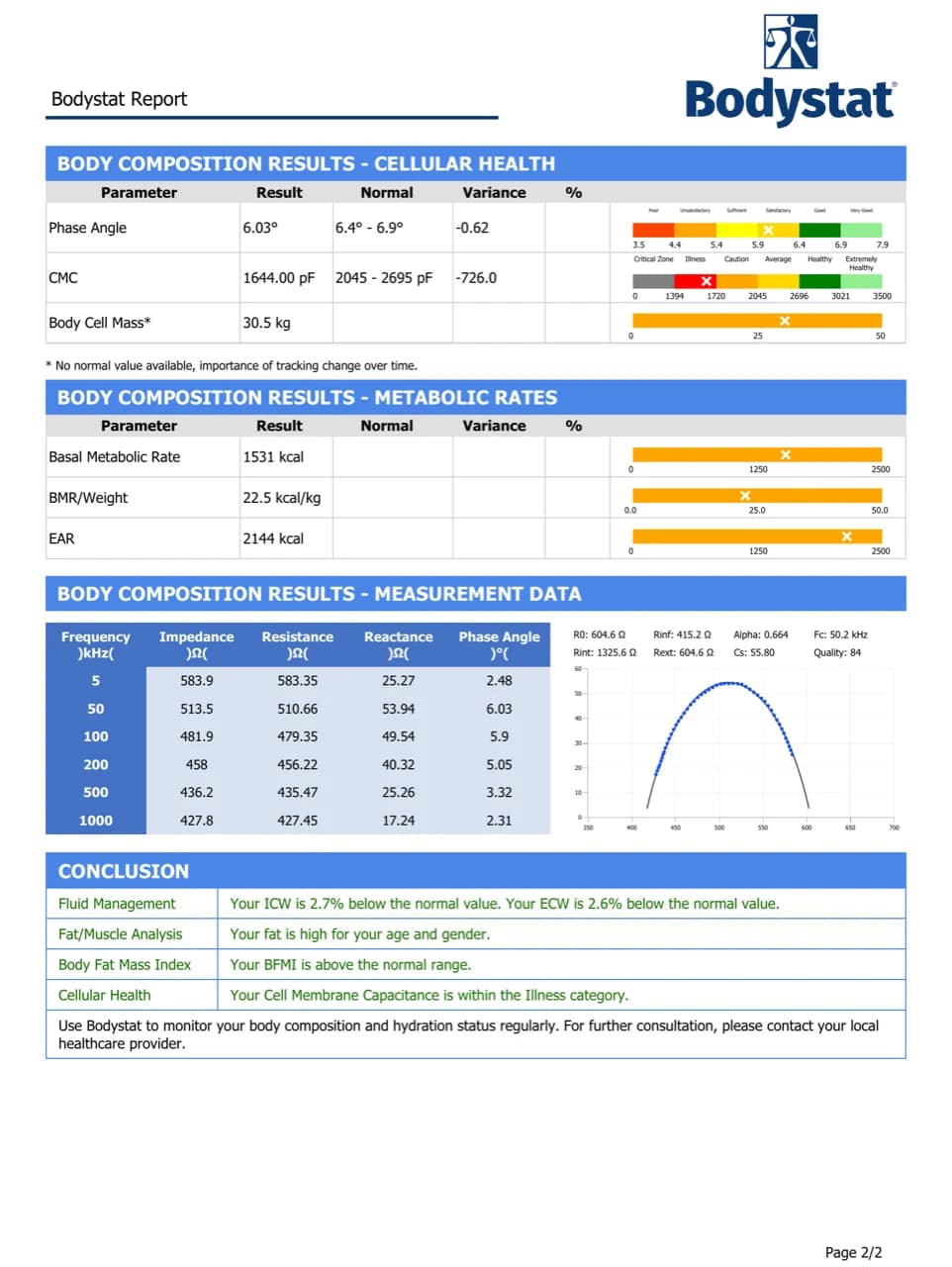
Sample report — anonymised data. Your report is always discussed by your nephrologist, never handed over raw without interpretation.
For whom, and when
Three moments where this measurement makes the most sense
At your first session
To establish a clear starting point: initial dry weight, hydration status, baseline body composition.
During regular follow-up
Periodic measurements to readjust your dry weight and detect malnutrition or muscle wasting early.
Visiting patients
For an extended stay (two weeks or more), a measurement may be offered to personalise your care — at no extra cost for CNAS / CASNOS members.
Medical honesty
What this tool does — and does not do
What it does
- Helps adjust the dry weight, alongside clinical judgement
- Tracks body composition over time
- Detects muscle wasting or malnutrition early
- Provides the phase angle, a marker of cellular integrity
What it does not do
- It does not determine your dry weight on its own — it helps your doctor do so
- It does not diagnose malnutrition on its own
- It does not replace blood tests or the clinical examination
- It measures neither cancer nor heart disease — it is not a screening test
Bioimpedance is a tool to support medical decision-making. Interpretation is the nephrologist's responsibility, who integrates it into your clinical file.
Is this measurement part of my follow-up?
If you are a patient at Clinique ESSAADA or are preparing for a dialysis stay, speak to your nephrologist at your next consultation. We will explain when and how to use it in your case.
A medical question
A question about your follow-up or this measurement?
Our nephrology team answers in consultation, by phone or via WhatsApp — Saturday to Thursday.