Technical transparency
The quality of your dialysis begins with the water and the equipment
A haemodialysis session brings your blood into contact with around 120 litres of treated water. At that volume, every detail matters. Here is what we put in place, with no simplification.
Dialysis machines
37 beds, one machine per station
Each dialysis station has its own machine, with traceability of session parameters.
Make and model
Brand-new dialysis machines.[Make and model: detailed technical information provided on request.]
Maintenance
Regular preventive technical inspection by an approved provider, with traceability of interventions station by station. A biomedical technician is present during sessions.
Traceability
Parameters of every session recorded — pressure, flow rates, conductivity, effective dialysis duration.
Water treatment
Five stages, one ultrapure water
Mains water passes through a treatment chain before entering the machine. A looped, sterilisable distribution network with no dead legs.
- 1
Sand filter
Retains suspended particles (sand, sludge, residues).
- 2
Water softener
Removes the calcium and magnesium that would scale the membranes.
- 3
Activated carbon filter
Captures chlorine and its by-products, which are toxic to the blood.
- 4
0.2 μm microfiltration
A physical barrier against residual bacteria.
- 5
Double-pass reverse osmosis
The final stage, producing ultrapure water that meets dialysis standards.
Regular checks: quarterly sampling — bacteriological and biochemical. Results available on request from the medical secretariat.
Technical gallery
What our biomedical team sees
A few views of the technical facility. A full photo report is on the way.
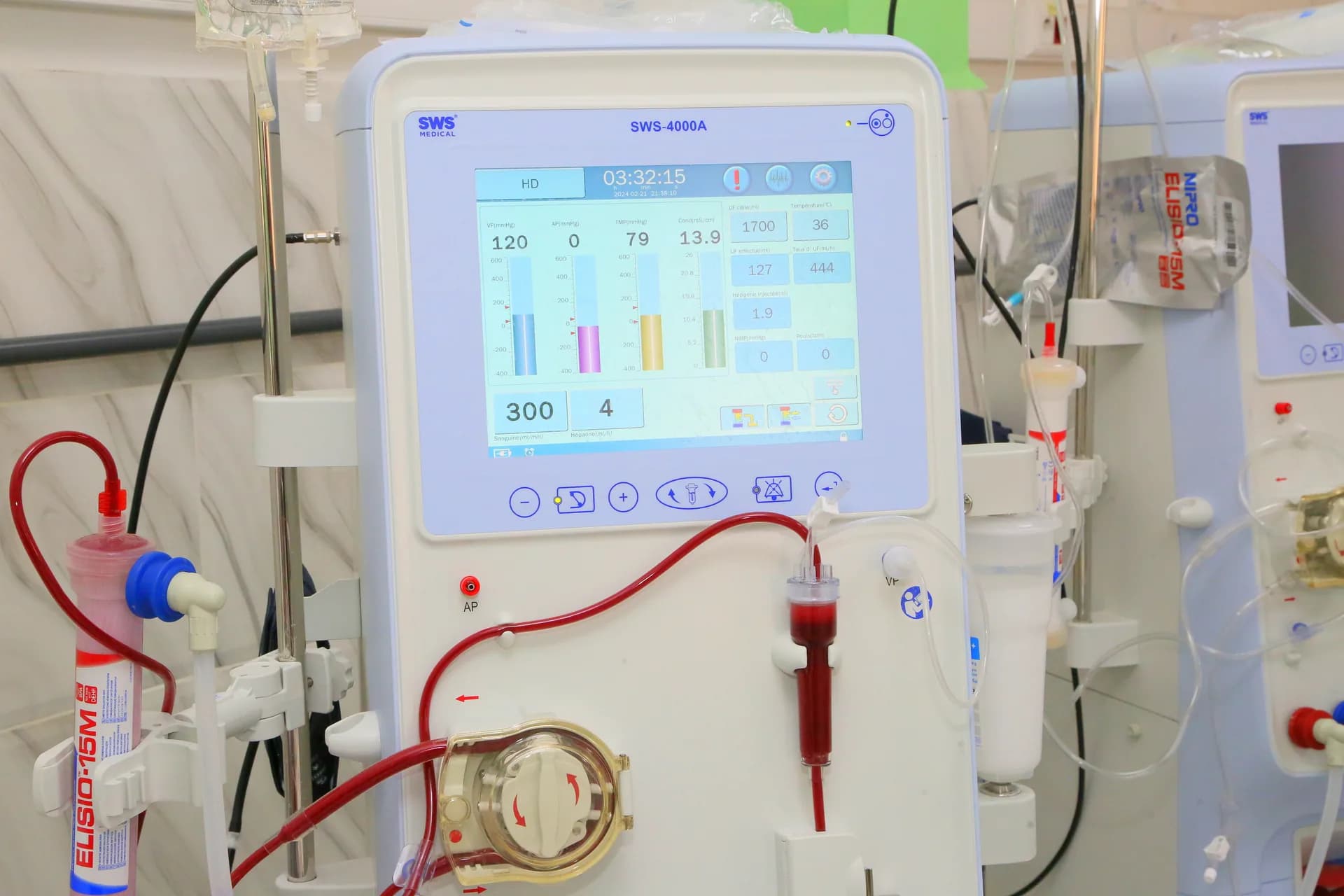
Detail Control interface — session parameters displayed in real time. 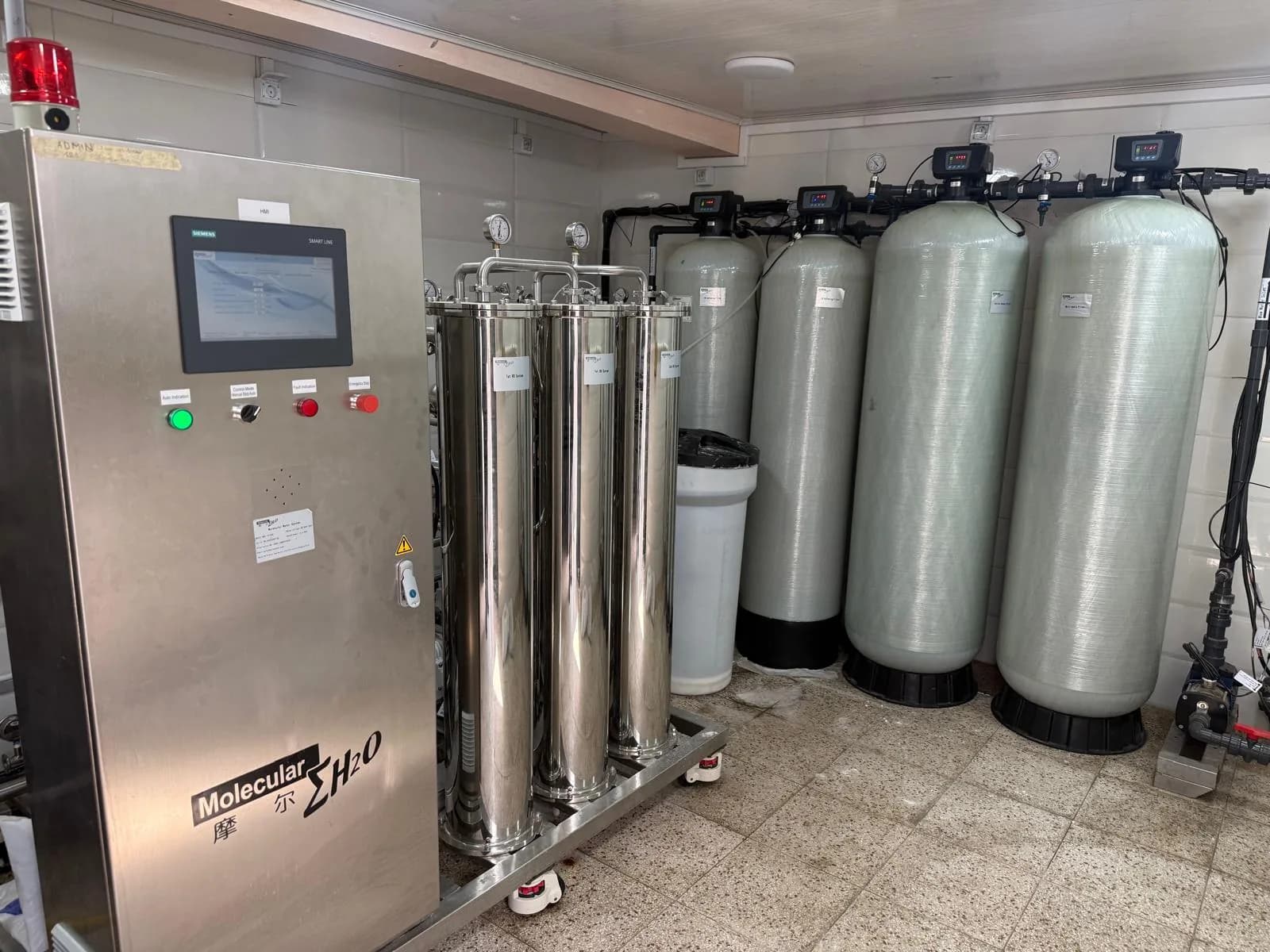
Water treatment Stainless-steel tanks, controlled pressure, ultrapure water production. 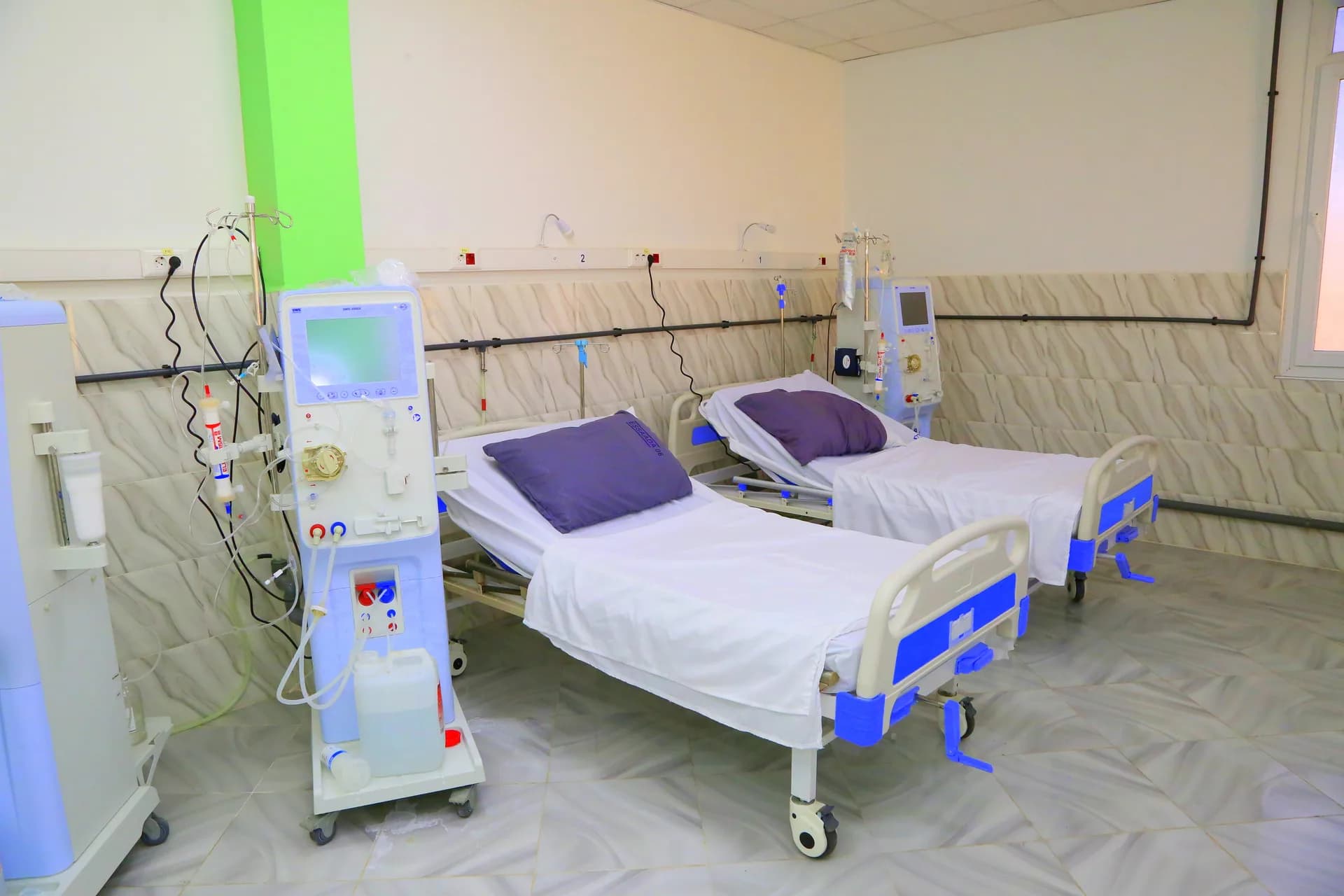
Hygiene Bio-cleaning between each patient, single-use equipment as standard.
Dialysers & circuits
Strict single use
No reuse of equipment, in line with current international standards.
Dialyser (the filter)
Biocompatible, high-permeability synthetic membrane, strictly single use.
Blood lines & needles
Single-use tubing and fistula needles. No reuse, in accordance with international standards.
This is an important point for our diaspora patients, used to this standard in Europe and North America.
Safety protocols
Protecting every patient at every session
- Screening on admission: routine HBV, HCV and HIV serologies
- Strict isolation of carrier patients (dedicated room or station, closed care circuit)
- HBV revaccination offered if protective serology is insufficient
- Full traceability: every session, every dialyser, every parameter recorded per patient
Care-staff ratio
A strong team present throughout the whole session
Nurses
Present continuously, trained in dialysis and emergency protocols.
Nephrologist
Continuous presence for the whole duration of sessions — not an on-call phone arrangement.
Biomedical technician
On site for immediate intervention in the event of a machine alarm.
Hygiene
Healthcare assistants and a hygiene officer dedicated to each room, bio-cleaning between each patient.
Quality control
Check, measure, improve — continuously
Water analyses
Quarterly sampling — bacteriological and biochemical.
Dialysis adequacy (Kt/V)
Measured regularly and discussed with you at your follow-up consultation.
Morbidity review
Weekly medical staff meeting — review of incidents, parameters and difficult cases.
Ministry of Health accreditation
Ministry of Health accreditation, CNAS and CASNOS agreements.
Going further
Precise measurement of dry weight and hydration
Beyond the dialyser and the machine, we have a multi-frequency bioimpedance device to objectively assess your body composition — a higher-level tool, common in some European centres.
Bodystat Multiscan 5000
Medical bioimpedance at 6 frequencies. Helps adjust dry weight, monitor lean mass / fat mass and measure the phase angle. A non-invasive, two-minute measurement, integrated into your follow-up.
Discover this measurementTechnical questions
A specific technical question?
Water quality, type of dialyser, the results of your latest analyses — our medical team answers in consultation or by phone.